
If I could only do three things for my child's immune system this winter…
Not another immune gummy. Not ten different supplements.
Just three things, and I'd get them right before anything else.
1. Look after their nose
I think we massively underestimate the nose when it comes to keeping children well.
In our PANS/PANDAS children especially, I have noticed something really interesting. When parents consistently use Xlear, a xylitol nasal spray, usually one spray into each nostril every day through winter, many of these children seem to pick up far fewer infections. (No affiliation, by the way. I just like it.)
That's my clinical observation. We don't have a PANS/PANDAS trial proving it.
But there is some science behind why it might be happening.
Xylitol appears to make the nasal environment less hospitable to certain bacteria and there is laboratory evidence around bacterial adherence and biofilm formation. In one small study of children with recurrent ear infections, infections fell from an average of 4.12 in three months to 1.06 while they were using xylitol nasal spray.
My suspicion is that we're helping the nose do what it's supposed to do: clear things out before they get a chance to hang around. I think it may go further than that. Bacteria can build biofilms, a slimy protective layer that lets them settle in and resist being cleared. If xylitol makes that layer harder to build, or helps break it down, the bacteria lose their shelter.
If Xlear doesn't suit your child, use saline.
But don't wait until they're ill.
Make nasal care part of winter, just like brushing their teeth.
If your child picks up one infection after another every winter, it is worth asking why. Working that out for each child is what we spend our days on at Brainstorm Health.
Book a free discovery call2. Don't just give vitamin D. Know their level.
October arrives and everyone starts giving vitamin D.
Fine.
But 800 IU means something very different in a child with a good vitamin D level than it does in a child who is severely deficient.
So test it.
You can ask your GP where appropriate, or a simple private finger-prick 25-OH vitamin D test is inexpensive and easy to do at home.
If they're low, correct it properly.
Then maintain it.
Because there is some good winter data here. In one study, children taking 800 IU daily had 17% fewer respiratory-infection sick days and 43% fewer days of infection with fever.
But please don't take that to mean that if 800 IU is good, 5,000 or 10,000 must be better.
Vitamin D doesn't work like that.
As exposure gets higher, the body actually increases the machinery it uses to break vitamin D down.
So I'm not interested in pushing children's levels higher and higher.
Test. Correct. Maintain.
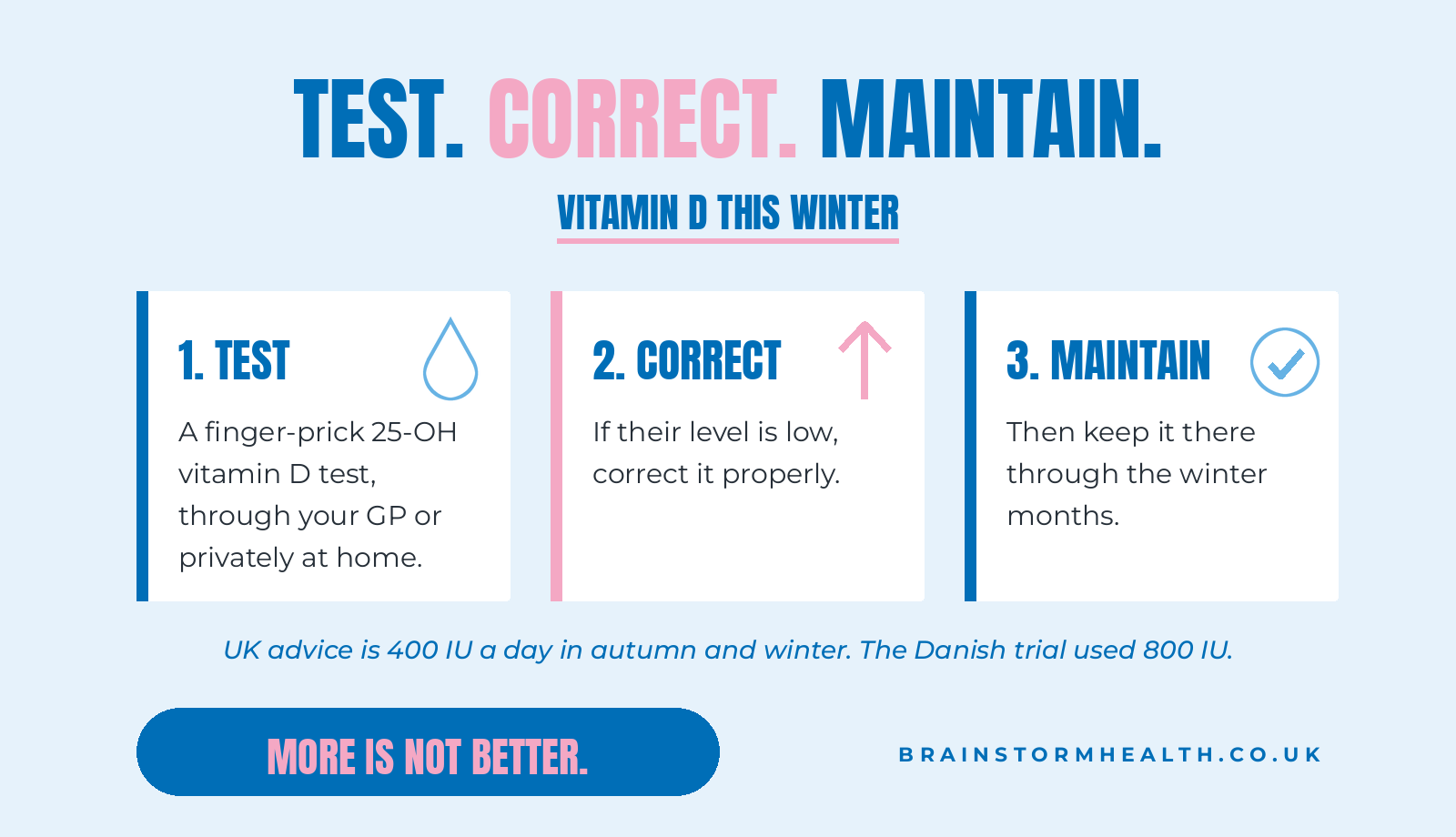
Vitamin D this winter. Test: a finger-prick 25-OH vitamin D test, through your GP or privately at home. Correct: if their level is low, correct it properly. Maintain: then keep it there through the winter months. UK advice is 400 IU a day in autumn and winter. The Danish trial used 800 IU. More is not better.
3. Get them sleeping
I cannot overstate this one.
Researchers tracked adults' sleep for a week with wrist monitors. Then they dripped a cold virus straight into their noses and waited.
Those sleeping five to six hours a night were around four times more likely to get a cold than those sleeping more than seven.
Four times.
So yes, get the screens off. Dim the lights. Get them outside into daylight in the morning. Keep bedtime reasonably consistent.
But most of our parents already know that.
The more important question is:
Why isn't your child sleeping?
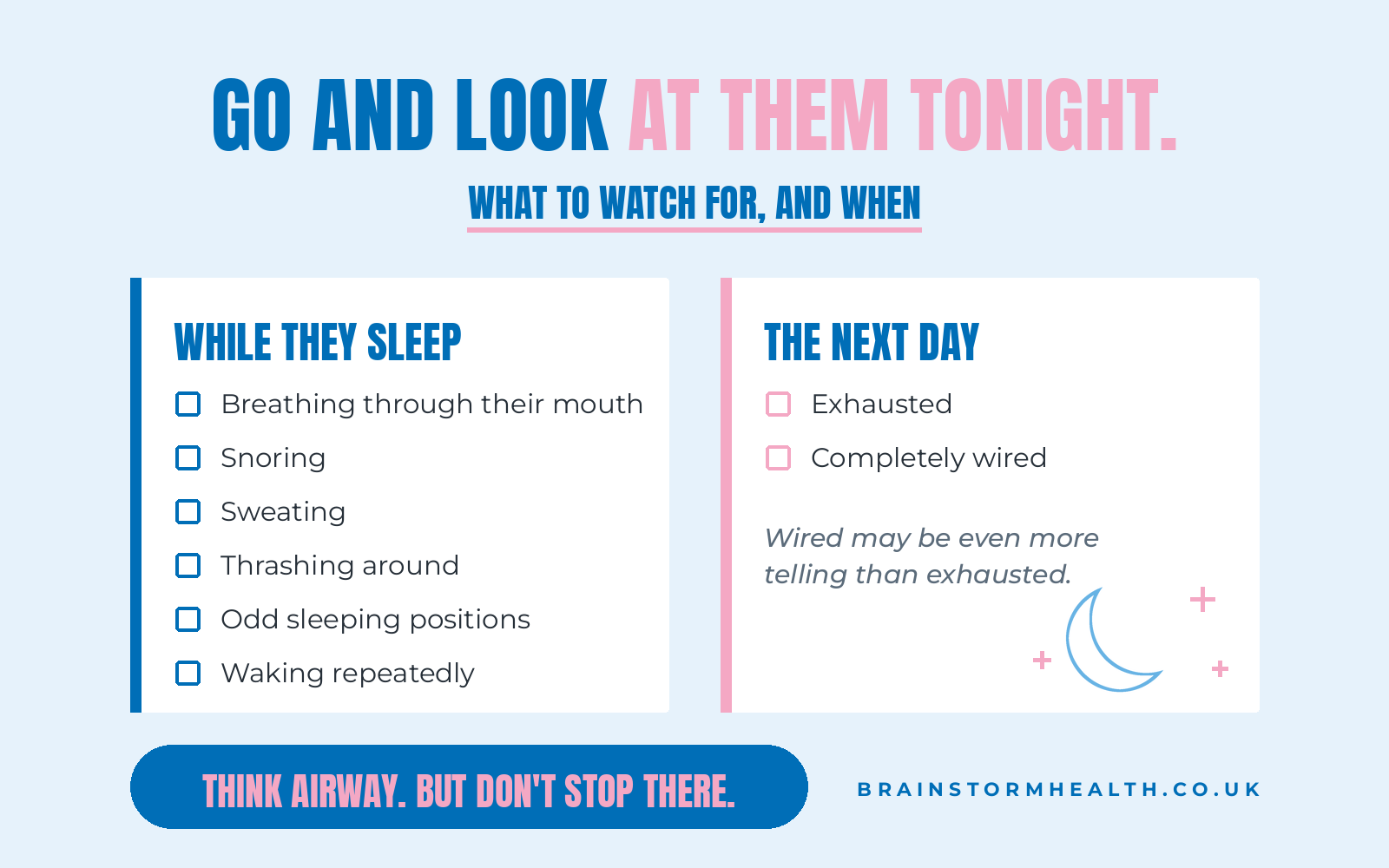
Sleep checklist. While they sleep: breathing through their mouth, snoring, sweating, thrashing around, odd sleeping positions, waking repeatedly. The next day: exhausted, or completely wired. Think airway, but don't stop there.
Go and look at them tonight.
Are they breathing through their mouth?
Snoring?
Sweating?
Thrashing around?
Sleeping in odd positions?
Waking repeatedly?
Are they exhausted the following day, or perhaps even more tellingly, completely wired?
Think airway.
But don't stop there.
Think reflux. Constipation. Pain. Restless legs. Iron. Anxiety. Medication. Circadian rhythm.
And think histamine and mast cells.
Histamine isn't just about hives and itching. Histamine is one of the brain's major wake-promoting neurotransmitters.
Some of the children we see are absolutely exhausted and yet seem physiologically incapable of switching off.
If histamine or mast-cell activation is part of the picture, address it. Sometimes that may mean mast-cell support, natural antihistamine approaches or, where appropriate, medication.
If magnesium is low or intake is poor, sort that too.
And if you've done all of this and your child simply cannot fall asleep, have a sensible conversation with their GP or paediatrician about melatonin.
The objective isn't to throw things at a child until they become sedated.
It's to work out what is keeping their brain and body awake and fix that.
Because sleep isn't just downtime.
It's part of immune function.
So if I wanted the biggest bang for my buck this winter?
Nose.
Vitamin D.
Sleep.
I'd get those three right before I worried about anything else.
IMPORTANT
This information is for educational purposes only and is not a substitute for professional medical advice, diagnosis or treatment. Always consult with medical doctors or qualified functional medicine practitioners before introducing any new supplement, test, or intervention.
If this has raised questions about your child, we'd love to help you find some answers.
REFERENCES
Margulis I, Cohen-Kerem R, Stein N, et al. Xylitol nasal spray for prevention of recurrent acute otitis media in children: a prospective two-center cohort study. Int J Pediatr Otorhinolaryngol. 2024;176:111818.
Jain R, Lee T, Hardcastle T, et al. The in vitro effect of xylitol on chronic rhinosinusitis biofilms. Rhinology. 2016;54(4):323-328.
Clerico JW, Thams L, Stounbjerg NG, et al. Effects of vitamin D supplementation on acute respiratory tract infections in 6-8-year-old children: a randomized clinical trial. Eur J Nutr. 2025;64:170.
Ketha H, Thacher TD, Oberhelman SS, et al. Comparison of the effect of daily versus bolus dose maternal vitamin D3 supplementation on the 24,25-dihydroxyvitamin D3 to 25-hydroxyvitamin D3 ratio. Bone. 2018;110:321-325.
NHS. Vitamin D. nhs.uk/conditions/vitamins-and-minerals/vitamin-d
Prather AA, Janicki-Deverts D, Hall MH, Cohen S. Behaviorally assessed sleep and susceptibility to the common cold. Sleep. 2015;38(9):1353-1359.
Thakkar MM. Histamine in the regulation of wakefulness. Sleep Med Rev. 2011;15(1):65-74.
Winkelman JW, et al. Treatment of restless legs syndrome and periodic limb movement disorder: an American Academy of Sleep Medicine clinical practice guideline. J Clin Sleep Med. 2025.