
Why Halloween Hits Some Children Harder
I came across a study this week that I hadn’t seen before. I think every parent who has ever blamed the Halloween sugar should know about it.
You’ll know the scene. Two children share the same bag of sweets. One is fine. The other is flushed, wired and climbing the furniture by seven o’clock, then can’t get to sleep, then wakes up spoiling for a fight. Most Halloween advice stops at “check the labels”. That’s sound advice, but it never answers the question parents actually ask me: why this child, and not their brother?
Here’s what I’d sort out before Saturday, and why.
1. Check the packets for six colours
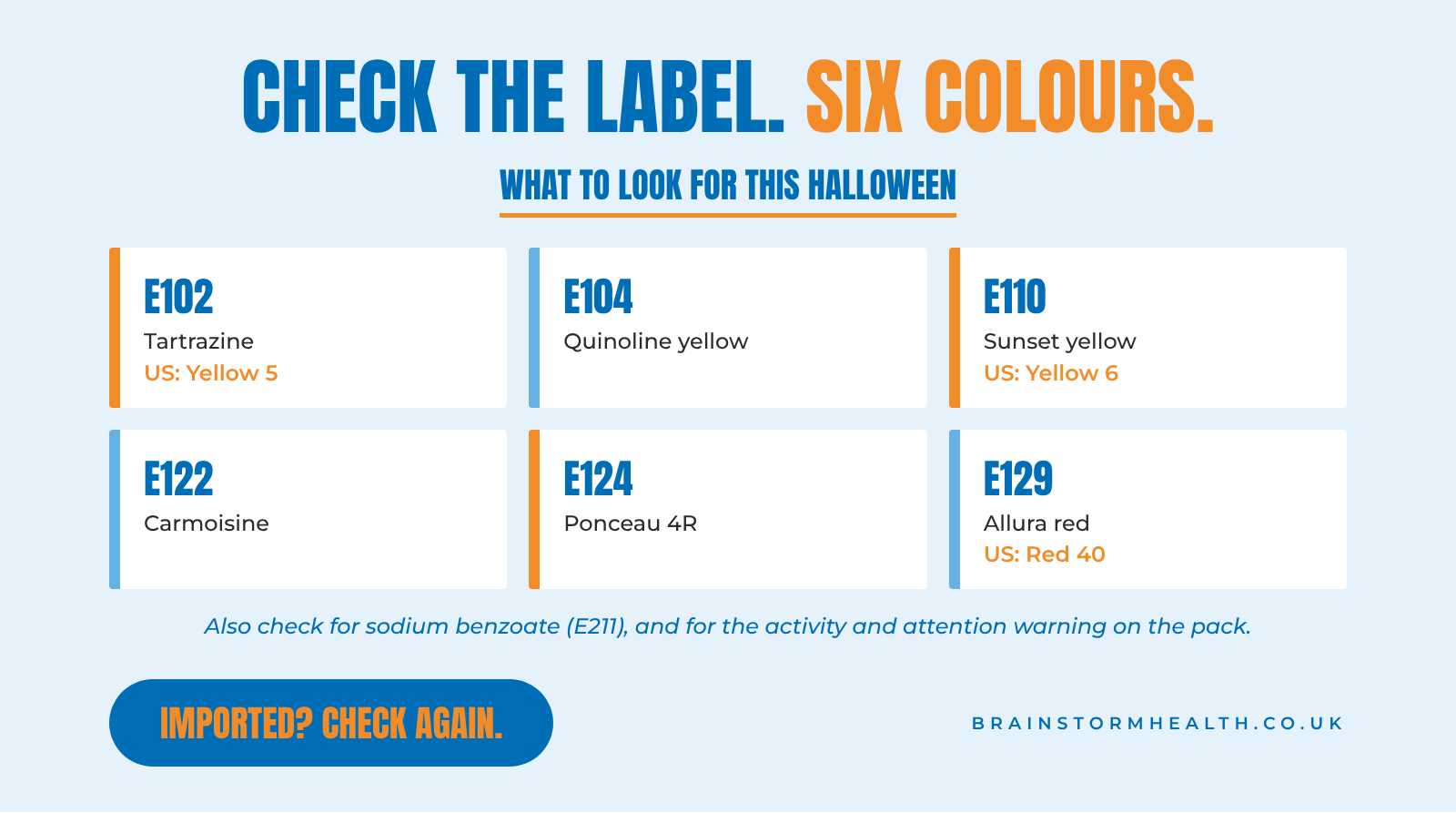
Look for these on the ingredients list:
E102 tartrazine
E104 quinoline yellow
E110 sunset yellow
E122 carmoisine
E124 ponceau 4R
E129 allura red
Anything containing them has to carry a warning that it may have an adverse effect on activity and attention in children. The colours are still permitted in the UK. In 2008 the Food Standards Agency asked manufacturers to remove them voluntarily, and many did, but not all.
Imported American sweets need a closer look, because the names change: Yellow 5 is tartrazine, Yellow 6 is sunset yellow and Red 40 is allura red.
The warning comes from a trial run at the University of Southampton in 2007. The researchers gave 153 three-year-olds and 144 eight- and nine-year-olds a fruit drink. Some drinks contained a mix of these colours with the preservative sodium benzoate, and some contained nothing added. Nobody involved knew which was which. These were ordinary children from the local community, not children with an ADHD label. Hyperactivity went up on the additive drinks in both age groups.
The average effect was small, and that’s the number sceptics like to quote. But a small average across a whole population can hide a minority of children who react very strongly. If you live with one of them, you already know it isn’t small.
2. Why it’s your child and not their brother
Three years after the trial, the same team went back to those children and looked at their genes. They wanted to know which children reacted most strongly.
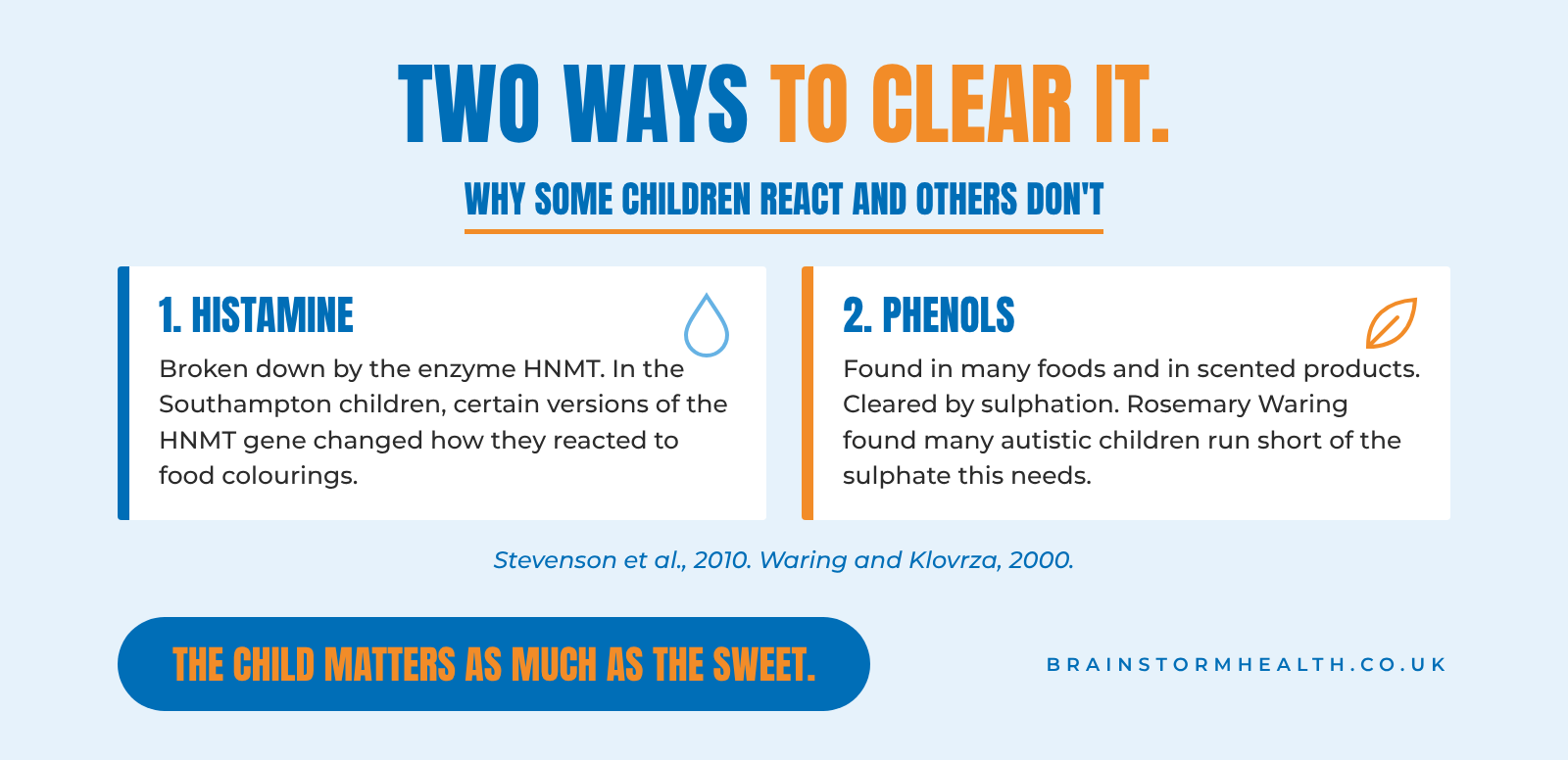
The clearest signal came from a gene called HNMT. It makes histamine N-methyltransferase, the enzyme that breaks down histamine inside cells, including in the brain. Children carrying certain versions of HNMT reacted differently to the additives, and this showed up in both age groups. The authors concluded that “histamine may mediate the effects of food additives on ADHD symptoms”.
Why does that matter? Because it moves the question away from the sweet and onto the child. Whether a colouring causes trouble seems to depend partly on what that child’s body does with histamine once the colouring has gone in. Many of the children we see already have a histamine problem, so this study joins up two things parents have usually been told are unrelated.
For Halloween, the practical upshot is simple. If your child is the one who reacts, the colour-free sweets matter more for them than for their sibling. Don’t let anyone tell you you’re being fussy.
If your child reacts to foods their brothers and sisters eat without a problem, there is usually a reason in how their body clears histamine and phenols. Finding that reason for each child, and working on it, is what we do at Brainstorm Health.
Book a free discovery call3. Phenols: the other half of the story
Histamine isn’t the only thing a child has to clear. Phenols are a large family of natural compounds found in many foods, and also in fragrances and scented products. The body clears them by sulphation. Rosemary Waring at the University of Birmingham found that many autistic children run short of the sulphate this needs, so phenols build up faster than they can be cleared. One clue is red cheeks and ears after eating.
In the children where a low phenol diet is the right call, we see much better behaviour, better sleep, less aggression, and less self-harm and anxiety. It’s the total load across the day that matters, not any single food, and peeling fruit and vegetables lowers it, because so much of it sits in the skin. I’ve written more about this in Bothersome Berries and Hyperactivity.
4. Think about the costume, the face paint and the mask
In the children who react to phenols, fragranced products often matter as much as food. A new costume straight out of the packet can smell strongly. A plastic mask puts that smell directly over your child’s nose and mouth for the whole evening.
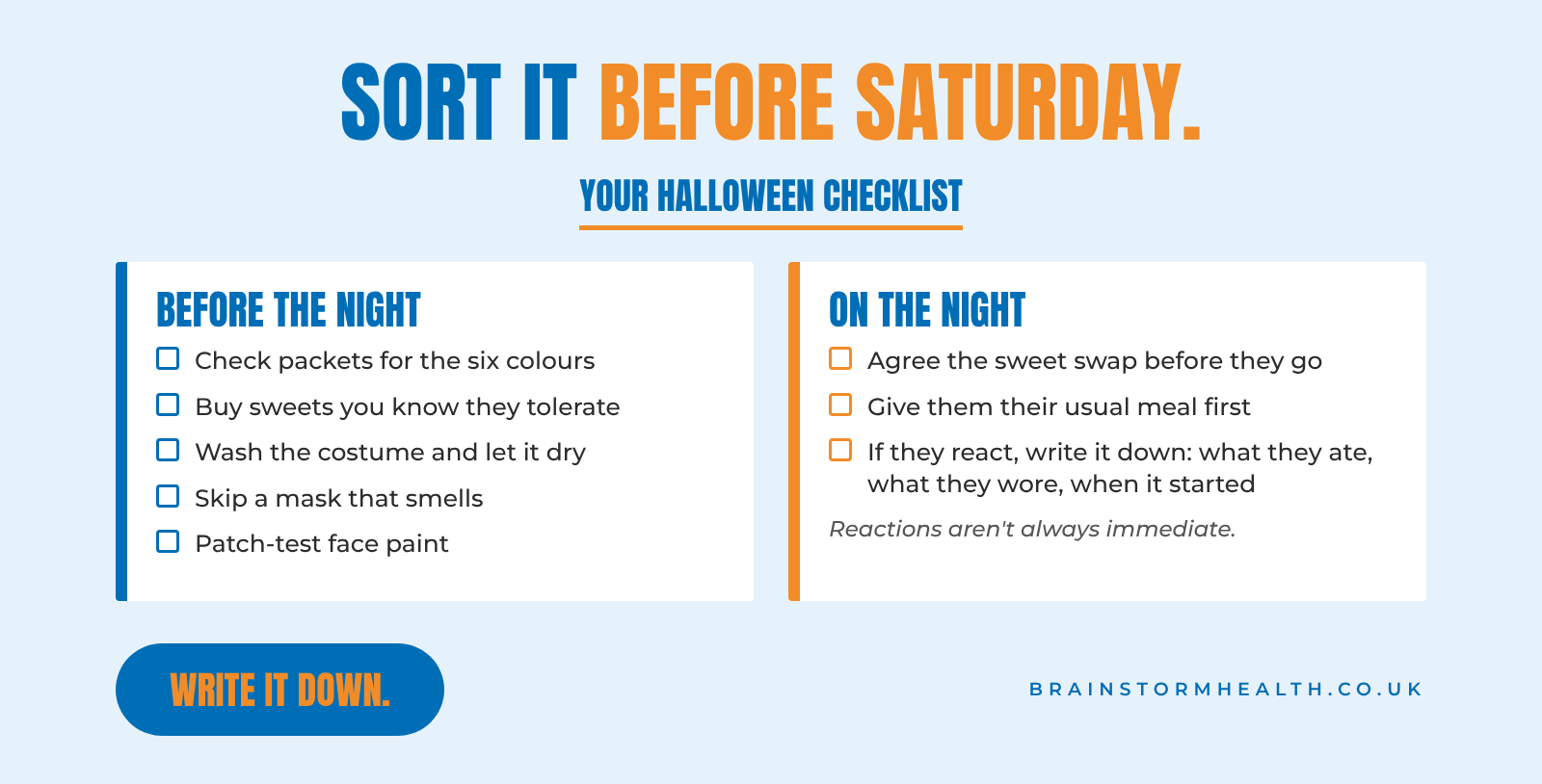
Wash the costume before the night in whatever you already use for their clothes, and let it dry fully. If it still smells or irritates their skin, change it. A costume made from clothes they already wear comfortably, plus the one item that makes the character recognisable, usually works fine. Skip the mask if it smells. Test any face paint on a small patch of skin a day or two before, especially if your child has eczema.
5. Plan the night itself
Buy a few sweets you know your child tolerates and have them ready at home. Agree the swap with them before they go out. Handing over a bucket they’ve just spent an hour filling is very different from a swap they helped plan.
Give them their usual meal before they go out, something they’ll actually eat.
If they do react, write it down: what they ate, what they wore, and when it started. Some children flush in the cheeks and ears within an hour or two, while behaviour can change a day or more later. A pattern on paper tells a practitioner far more than a memory of a bad weekend.
Same sweets. Different child. That difference is worth finding.
IMPORTANT
This information is for educational purposes only and is not a substitute for professional medical advice, diagnosis or treatment. Always consult with medical doctors or qualified functional medicine practitioners before introducing any new supplement, test, or intervention.
If this has raised questions about your child, we'd love to help you find some answers.
REFERENCES
McCann D, Barrett A, Cooper A, et al. Food additives and hyperactive behaviour in 3-year-old and 8/9-year-old children in the community: a randomised, double-blinded, placebo-controlled trial. Lancet. 2007;370(9598):1560-1567.
Stevenson J, Sonuga-Barke E, McCann D, et al. The role of histamine degradation gene polymorphisms in moderating the effects of food additives on children’s ADHD symptoms. Am J Psychiatry. 2010;167(9):1108-1115.
Waring RH, Klovrza LV. Sulphur metabolism in autism. J Nutr Environ Med. 2000;10(1):25-32.