
Probiotic, prebiotic, postbiotic. A guide for parents who are already paying attention.
You may have started to see the word postbiotic appearing, whether in supplement adverts, nutrition magazines; often the word is seen in the same paragraph as probiotic and prebiotic, interchangeably.
It is not interchangeable! Postbiotic is a distinct category, with its own definition, its own evidence base, and its own role.
Because it is so easily confused with the terms you already know, I want to take the time to explain what it actually is, where it fits, and what, if anything, it might offer your child.
The category ‘postbiotic’ was formally defined in 2021. Some of what is being sold under the label is rebranded marketing. The term is genuinely new and worth understanding, particularly for children with PANS, PANDAS or autism.
The three terms, properly distinguished
Probiotic, prebiotic, postbiotic. They sound almost identical, but they are not.
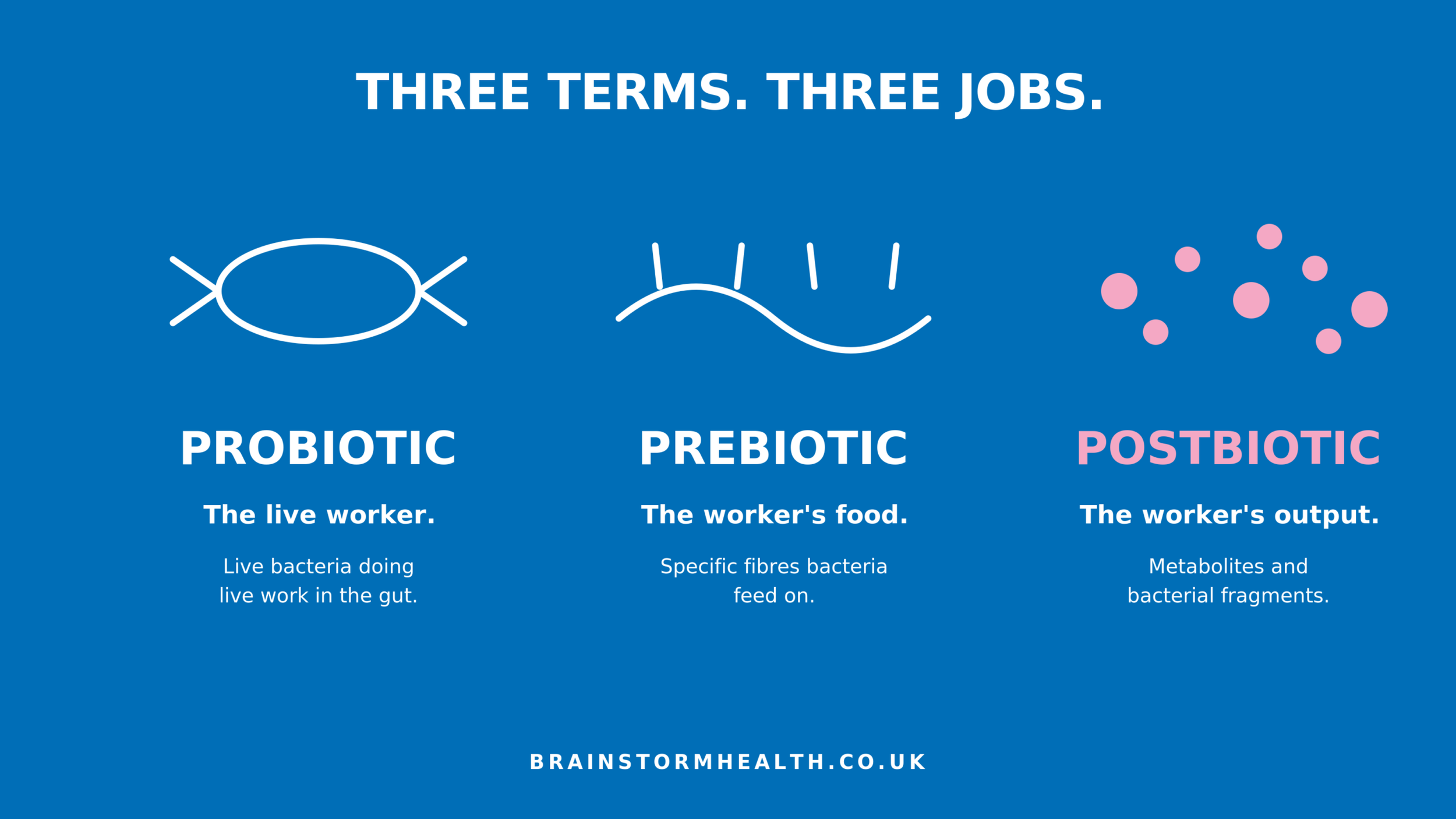
Probiotic. Live microorganisms that, when given in adequate amounts, confer a health benefit, such as…
The bacteria in your child's capsule
The live cultures in unpasteurised yoghurt
Live organisms doing live work in the gut.
Prebiotic. Food for probiotics, notably specific fibres and carbohydrates that beneficial bacteria preferentially feed on.
Inulin
Fructo-oligosaccharides
Galactooligosaccharides
When you give a prebiotic, the bacteria already in the gut metabolise it and grow.
Postbiotic. What the bacteria produce after they have done their work, or the bacterial fragments themselves once they are no longer alive.
Short-chain fatty acids like butyrate
Bacteriocins
Cell wall components
Secondary metabolites
To sum up…
Probiotic: the live worker
Prebiotic: the worker's food
Postbiotic: the worker's output
That distinction is what the International Scientific Association for Probiotics and Prebiotics set out to make clear in its 2021 consensus definition, after years of these terms being used loosely in the literature and even more loosely in marketing.
Why a separate category exists
You might wonder why anyone would supplement with postbiotics directly when probiotics and prebiotics should produce them in the gut anyway. The answer is that for many people, the production isn't happening: the butyrate-producing bacteria are depleted and the gut barrier is loose. The standard probiotic strains being added don't always colonise, and even when they do, they don't always produce the metabolites that matter at the levels the gut needs. Giving the metabolite bypasses the production step.
There is also a safety dimension: live bacteria carry a small risk of translocation in immune-compromised patients, while postbiotics, being inanimate, do not. This is why much of the early postbiotic interest came from oncology and inflammatory bowel disease, where live probiotics are sometimes contraindicated.
What the evidence does and does not say
The postbiotic evidence base in adults is good and growing. Postbiotic supplementation, particularly butyrate, has reasonable evidence for gut barrier repair and for reducing inflammatory cytokines including IL-6, TNF-alpha and IL-1 beta, with most of this work done in adults with inflammatory bowel disease and related conditions.2
The paediatric evidence base is thinner. The neuroimmune-specific evidence, in PANS, PANDAS, autism, is thinner still. Most of what we apply to our patient group is reasoned extrapolation, taking the mechanisms shown in adult trials and asking whether they apply to children whose biology shares the relevant features.
That extrapolation is reasonable in some respects, less so in others.
Where postbiotics might matter for our patient group
Children with PANS, PANDAS and autism share two clinical features that map directly onto what postbiotics do.
The first is gut barrier disruption. iFABP, zonulin, calprotectin. When these markers are abnormal, the gut barrier is leaking, and the immune system is responding to material it shouldn't be seeing. Butyrate, the most-studied postbiotic, is the primary fuel for the cells that hold that barrier closed. Supporting it is mechanistically rational.
The second is immune dysregulation. Postbiotic compounds interact with pattern recognition receptors on innate immune cells. They modulate T cell populations and cytokine profiles. For a child whose immune system has polarised into chronic inflammation, this regulatory effect is in the direction we want to move. The mechanisms align with what these children's biology needs, which is why the category is worth understanding properly rather than dismissing as a trend.
The four categories of postbiotic supplement
For families who want to understand what is actually on the market, supplemental postbiotics fall into four broad categories.
Butyrate and other short-chain fatty acids. Sodium butyrate, calcium-magnesium butyrate, and tributyrin, a fat-bound form that releases butyrate further down the gut. The evidence in adults for inflammatory bowel disease and gut barrier repair is reasonable. Tributyrin is more practical for paediatric use because of palatability.
Heat-killed (tyndallised) probiotic strains. Lactobacillus paracasei MCC1849 has published immune-modulation data from a randomised, double-blind, placebo-controlled trial in adults.3 Heat-killed strains are stable, do not need refrigeration, and can be used in children where live probiotics are contraindicated.
Bacterial fermentation products. Saccharomyces cerevisiae fermentates are the best known.
Bacterial lysates. These are more pharmaceutical than supplement. Used in recurrent respiratory infections in some paediatric settings, including parts of the UK.
These categories are not interchangeable: a heat-killed Lactobacillus is not the same intervention as butyrate, and a Saccharomyces fermentate is not a substitute for either.
A practical caution: "Postbiotic" has become a marketing term, and a growing number of products carrying the label are not really postbiotic in the ISAPP sense; they are probiotic-prebiotic blends or spore-formers rebranded for the new buzzword. The ingredient list is what tells you what you are actually buying.
What this means for families
‘Postbiotic’ is a real, distinct category, with a defensible scientific basis and a growing evidence base, mostly in adults.
For our patient group, the underlying mechanisms align with what these children need. The application requires the usual care. Match the form to the child. Match the timing to where you are in the wider plan. Test before you supplement when the gut picture is unclear.
Don't trust the label alone, as the ingredient list will tell you whether what is in the bottle is what is on the front of it.
Don't take postbiotics as one more thing to bolt on without thinking. The postbiotic question, like every other gut intervention for these children, is specific. Which form. In which child. Alongside which other interventions.
IMPORTANT
This information is for educational purposes only and is not a substitute for professional medical advice, diagnosis or treatment. Always consult with medical doctors or qualified functional medicine practitioners before introducing any new supplement, test, or intervention.
If this has raised questions about your child, we'd love to help you find some answers.
REFERENCES
1. Salminen S, Collado MC, Endo A, et al. The International Scientific Association of Probiotics and Prebiotics (ISAPP) consensus statement on the definition and scope of postbiotics. Nature Reviews Gastroenterology & Hepatology. 2021;18(9):649-667. doi:10.1038/s41575-021-00440-6.
2. Wang S, Han X, Zhang Y, et al. Postbiotics in inflammatory bowel disease: efficacy, mechanism, and therapeutic implications. Journal of the Science of Food and Agriculture. 2025;105(2):721-734. doi:10.1002/jsfa.13721.
3. Kato K, Arai S, Sato S, Iwabuchi N, Takara T, Tanaka M. Effects of Heat-Killed Lacticaseibacillus paracasei MCC1849 on Immune Parameters in Healthy Adults — A Randomized, Double-Blind, Placebo-Controlled, Parallel-Group Study. Nutrients. 2024;16(2):216. doi:10.3390/nu16020216.