
Why The Brain Can Repair
WHY A LONGEVITY STUDY MATTERS FOR AUTISM, PANS AND PANDAS
You may be wondering why I am covering a longevity study in a clinic focused on autism, PANS and PANDAS. On the surface these fields have nothing in common. One studies ageing in adult neurons, the other deals with sudden regressions, behavioural storms and disrupted development in children. The science says they belong in the same conversation.
The longevity paper revealed something essential. Neurons do not fail because they are old, they fail because their regulatory system is pushed into chaos by stress. When that stress is removed the cells regain function and communicate again, as if the ageing signal never happened.
This is the same pattern we see in our children. Skills disappear because its regulatory environment collapses under immune activation, inflammation and metabolic pressure. This is why many children with profound behavioural change still show completely normal MRI scans. It is the internal environment that has fallen apart. When that pressure lifts, the original developmental pathway returns.
WHAT THE STUDY SHOWED
Scientists stressed neurons in the eye using injury and metabolic pressure. Within days, the cells behaved as if they were biologically older: signalling dropped, gene regulation became unstable and function declined. The neurons were intact albeit dysregulated.
When the regulatory environment was restored, the same cells switched back on: vision returned, communication improved, and repair restarted.
WHY REGULATION MATTERS
Recovery depended on Tet enzymes, which repair disrupted gene regulation. These enzymes only work when key metabolic conditions are in place:
alpha ketoglutarate
active iron
vitamin C
oxygen
balanced redox state
stable mitochondrial output
steady methylation chemistry
These same systems often falter in autism, PANS and PANDAS. When they fail, the brain cannot access existing pathways. When they stabilise, abilities return.
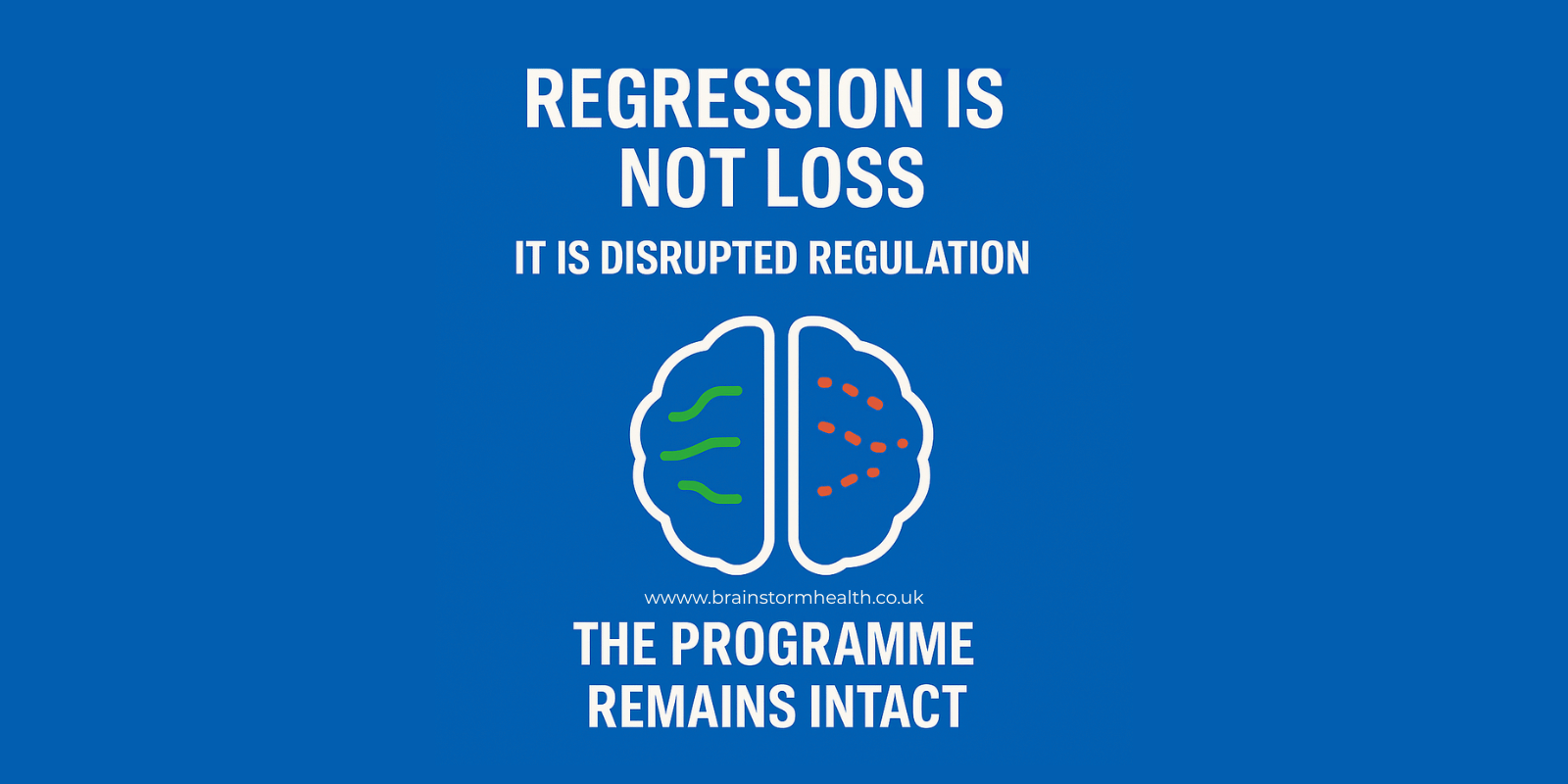
REGRESSION IS BLOCKED ACCESS, NOT LOSS
Regression can look like disappearance (speech drops, tolerance narrows, learning stalls). The study explains why: stress pushes neurons into a dysregulated state where they cannot access normal instructions.
Access returns when inflammation falls and metabolic strain eases. This is why improvements can be rapid, specific and precise.
THE PARALLEL
Children under chronic immune and metabolic pressure show the same pattern. Their biology behaves “older” than it is. Remove the pressure and the system reopens.
WHAT WE SEE IN PRACTICE
Testing consistently shows:
regulation fails before structure
metabolism shapes epigenetics
inflammation blocks repair
mitochondria determine resilience
gut signals influence neurological stability
the developmental blueprint remains present
WHAT THIS MEANS IN PRACTICE
Lower inflammatory load
Resolve gut inflammation and dysbiosis.
Clear immune triggers
Address chronic infections and immune confusion.
Rebuild metabolic capacity
Support mitochondria and redox balance.
Restore essential cofactors
Iron, vitamin C, folate, B vitamins and minerals.
Stabilise gut-brain signalling
Repair the gut barrier and reduce neural danger signals.
As regulation returns, function returns: behaviour steadies, learning reopens, sensory tolerance improves, communication re-emerges.
THE MESSAGE PARENTS NEED TO HEAR
The longevity study shows that regression is biochemical and recovery is biological. The potential remains intact.
IMPORTANT
This information is for educational purposes only and is not a substitute for professional medical advice diagnosis or treatment. Always consult with medical doctors or
qualified functional medicine practitioners
before introducing any new supplement test or intervention.
Concerned about your child’s health? We are happy to talk.
References
Lu Y, Brommer B, Tian X, et al. Reprogramming to recover youthful epigenetic information and restore vision. Nature.
PubMed |
Nature
Rossignol DA, Frye RE. Mitochondrial dysfunction in autism spectrum disorders: a systematic review and meta-analysis. Molecular Psychiatry.
PubMed |
Journal
O’Neill LAJ, Pearce EJ. Immunometabolism governs dendritic cell and macrophage function. Journal of Experimental Medicine.
PubMed |
Journal
Rieder R, Wisniewski PJ, Alderman BL, Campbell SC. Microbes and mental health: a review. Brain, Behavior, and Immunity.
PubMed |
Journal