

Cut out seed oils. Give more fish oil. They’re two of the most common pieces of advice about fats right now, and they sound sensible. Plenty of careful, well-read parents have followed both.
Last week I spent the day with some of the world’s leading lipid scientists. On both counts, they saw it differently, and what they said changes how we think about the fats that go into our children.
1. The seed was never the problem
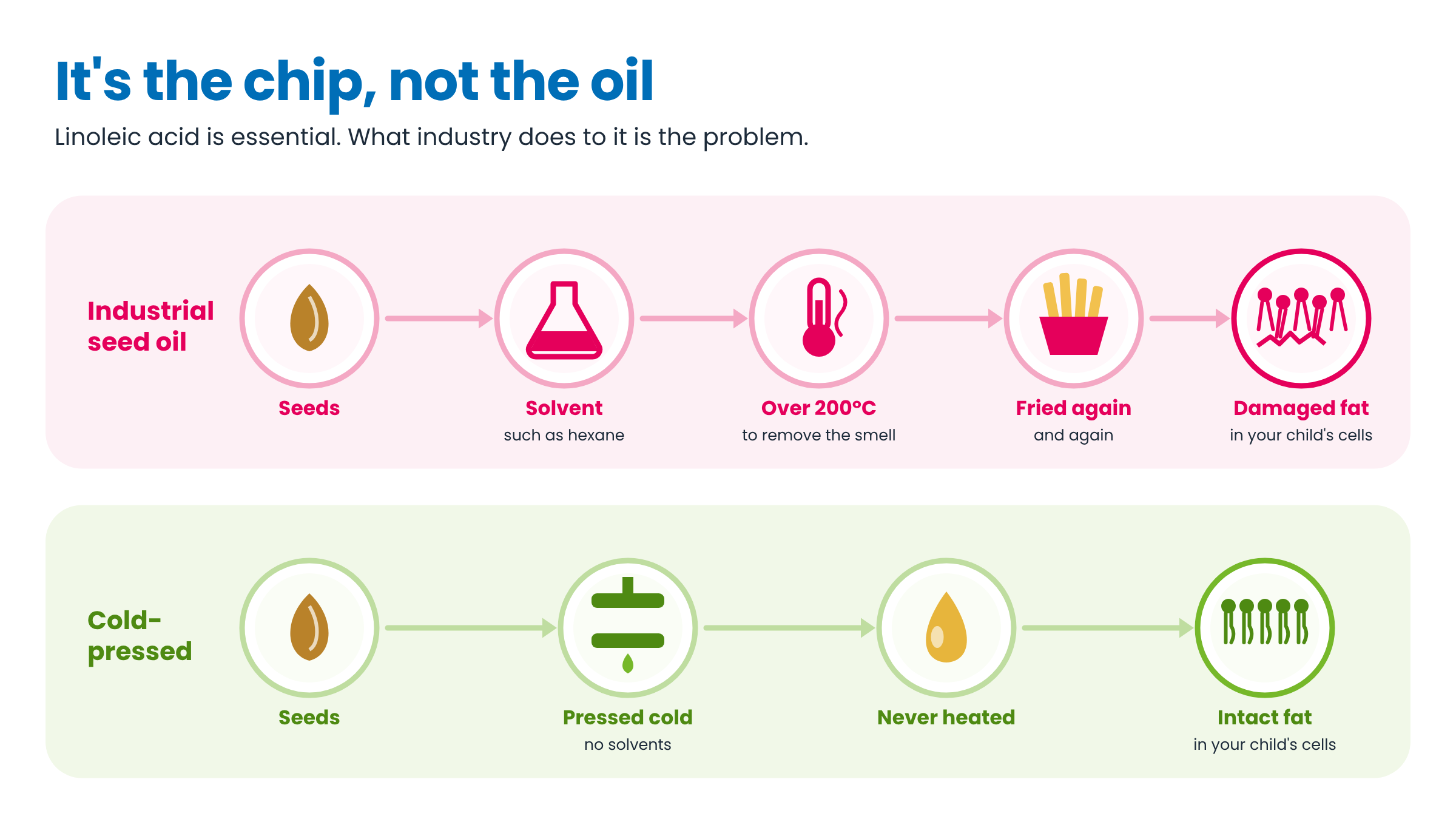
A sunflower seed is a sealed little packet of linoleic acid, a fat your child’s body can’t make and can’t do without. Crack it open fresh and that fat is intact.
Now follow it to the chip shop.
First it’s soaked in a chemical solvent to get the oil out. Then it’s heated past 200°C to strip the smell. That heat wrecks the fragile fat, destroys the plant’s own antioxidants, and creates a contaminant Europe’s food safety authority considers genotoxic. Then it goes into a fryer and gets cooked again, and again, and again.
By the time it reaches your child’s plate, it isn’t the fat that went into the seed.
And it doesn’t stay on the plate. It’s built into the membrane of every cell in your child’s body, brain included. Dr Patricia Kane’s rule of thumb: the darker the chip, the older the oil.
The British Society for Ecological Medicine has just published a statement making exactly this point. Bin every seed oil and you bin an essential fat along with the damaged one. The oils we use in clinic are cold-pressed and never heated.
2. More fish oil can mean less DHA
Fish oil feels like the safe bet. If a little is good, more must be better.
Dr Kane showed blood tests from people taking high doses. One omega-3, EPA, was off the chart. The other, DHA, the fat the brain is actually built from, was low. The balance had tipped the wrong way.
Then she showed us a boy with seizures. He’d spent three years on a ketogenic diet built on hydrogenated fat, with heavy doses of fish oil on top. His linoleic acid, the seed oil fat everyone is being told to avoid, was far below range. Once his oils were corrected, she reported that he walked for the first time within a month.
That’s why we mostly use algae oil rather than fish oil. Professor Charles Serhan, the Harvard scientist who discovered how the body switches inflammation off, told the room he takes algae-based DHA himself.
Fish oil also goes rancid easily, and you’d never know from a capsule. If fish oil is your preference, a liquid oil is a much better option, because you can smell it. It should smell fresh, and it should come from a reliable source with third-party testing.
If you've been giving your child fish oil for months without seeing the change you hoped for, or you're not sure which fats they need, the place to look is what their cell membranes are built from. Finding that out for each child, and working on it, is what we do at Brainstorm Health.
Book a free discovery call3. Why the balance matters
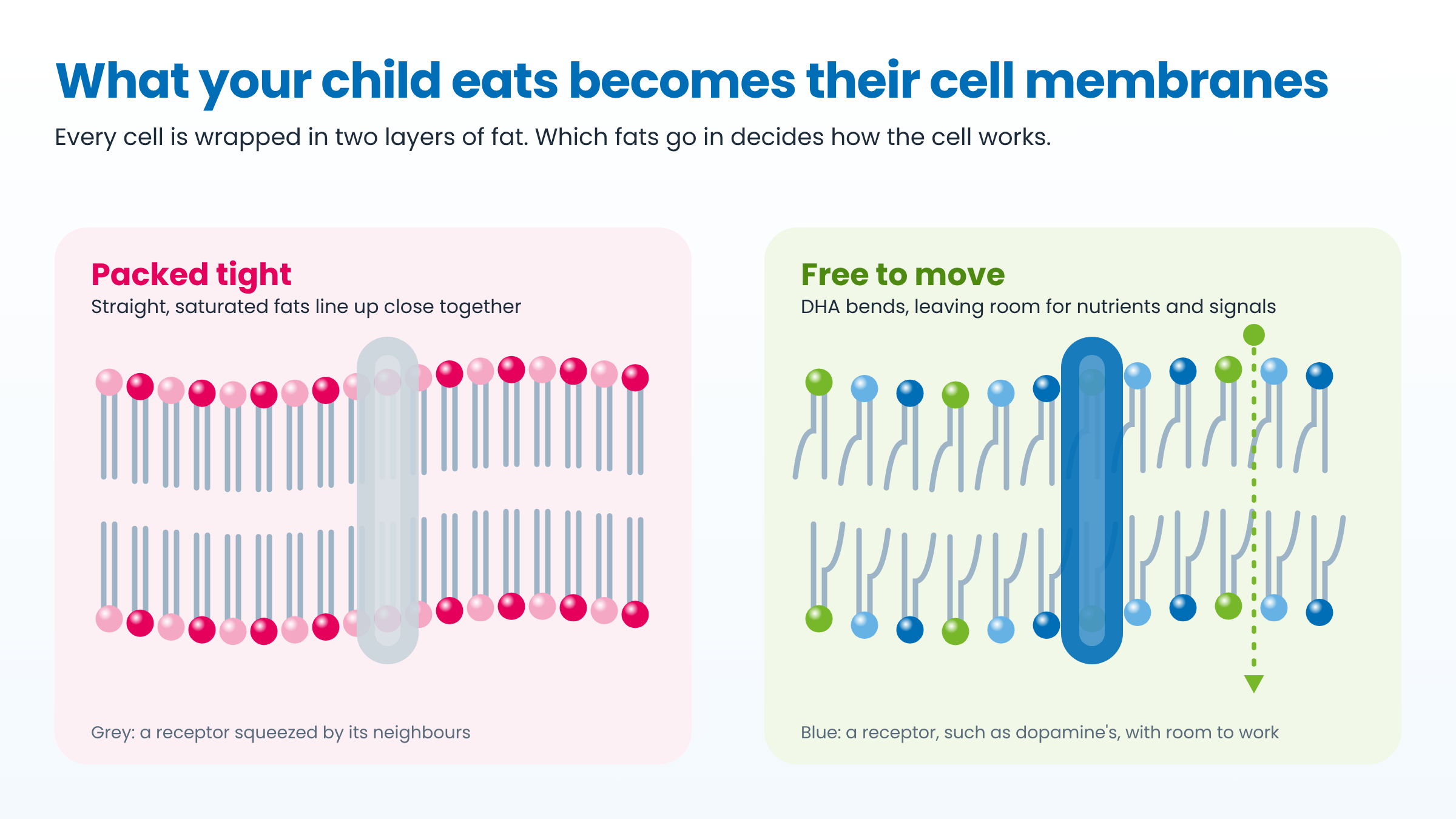
Every cell in your child’s brain is wrapped in a membrane made of fat, and that membrane is built from whatever fats come in.
Straight, saturated fats pack together tightly. DHA bends, and keeps the membrane flexible and moving. Nutrients get in through that membrane, signals cross it, and every dopamine receptor sits in a ring of it.
Get the fats wrong and the receptor doesn’t behave the way it should.
4. Inflammation is meant to switch itself off
Professor Serhan asked us to picture a spot on your arm: red, angry and full of white cells. Leave it two days and it’s gone.
Where did all those white cells go?
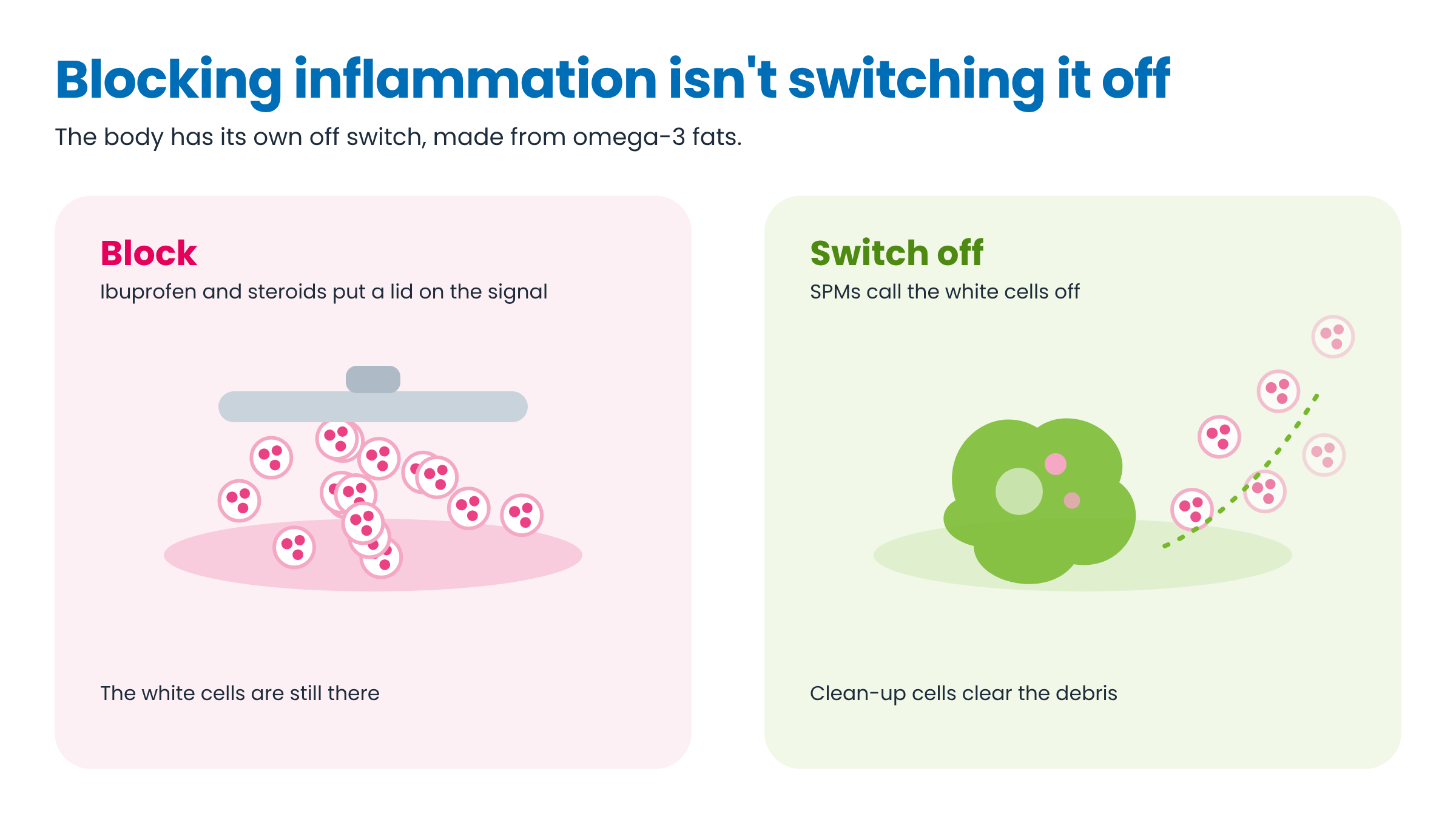
For decades, the textbooks didn’t even ask. Serhan has spent his career finding the answer. Inflammation doesn’t just fade away. The body switches it off on purpose, using molecules made from omega-3 fats called SPMs. They tell the white cells to stop flooding in, and they bring in clean-up cells to clear the debris.
Ibuprofen and steroids work differently. They block inflammation. That puts a lid on it, but it doesn’t switch it off, and Serhan warned the room about the strain these drugs put on the kidneys.
Think of a child who flares after every cold and takes weeks to come back down. The question isn’t only what lit the fire. It’s why the off switch isn’t working.
Two more points from his talk. Breast milk is full of SPMs, so nature hands them over from the very first feed. And small, regular amounts train the body to make more of its own. We’ll be using SPMs more in clinic, with the products we’ve found work well.
5. Inflammation in the mouth doesn’t stay there
Serhan has spent years on gum inflammation, for a reason most parents wouldn’t guess: it leaks. Inflammatory signals from sore gums get into the bloodstream and travel around the body.
He recommended a Finnish mouth rinse called IsoDent. We’re going to try it with some of our children, especially those who keep getting throat infections, and see how we get on.
6. The membrane keeps a record
Dr Kane’s was the talk I found most impressive, and she opened with the question every parent of a child with a genetic label has asked.
Line up a hundred children with the same condition. Some are mildly affected. Others are devastated. Why?
Her answer: what they’ve eaten, what they’ve been exposed to, and how their membranes have been built.
The membrane keeps a record of all of it. After a toxic hit, abnormal fats build up in it: very long-chain, branched and odd-chain fatty acids. She calls them renegade fats. She first found them in children with autism in 1995.
7. Build first, then clear
When a child’s fat levels are very low, Dr Kane puts the right fats in before anything else. Dr Andreas Grossgold, a paediatrician from Florida, added the other half: clear the toxins without rebuilding the membrane, and the renegade fats come back.
Also in the room
Professor Michael Crawford has been warning since the 1970s that the brain evolved on food from the sea and that we’re starving it of DHA.
Two researchers from Cardiff University. Professor Dipak Ramji is studying DGLA, made from the GLA in evening primrose oil, which reduces inflammation in preclinical models. Dr Irina Guschina showed that what’s in a stool test doesn’t tell you what reaches the blood.
Dr Kane also announced a new test in the US that will show whether each membrane fat has been damaged.
So how do you know what your child is built from?
You measure it.
And this is news I’m really pleased about. We’ll soon be working with Dr Kane so our families can have the red cell fatty acid test from the Kennedy Krieger Institute, linked to Johns Hopkins. Each sample goes through a nine-hour analysis in a university laboratory and shows what your child’s membranes have been built from over the last few months.
More on this very soon.
Throw out the seed oils. Take more fish oil. Both sound simple, and neither is what the science in that room supports.
Cold-pressed oils, not industrial ones. Algae oil first, and fish oil only when it’s the right fit for the child.
IMPORTANT
This information is for educational purposes only and is not a substitute for professional medical advice, diagnosis or treatment. Always consult with medical doctors or qualified functional medicine practitioners before introducing any new supplement, test, or intervention.
If this has raised questions about your child, we'd love to help you find some answers.
REFERENCES
Downing D, Pouria S, Kane PC. Seed oils, linoleic acid and cardiolipin: a statement. British Society for Ecological Medicine. 16 October 2026.
EFSA Panel on Contaminants in the Food Chain (CONTAM). Risks for human health related to the presence of 3- and 2-monochloropropanediol (MCPD), and their fatty acid esters, and glycidyl fatty acid esters in food. EFSA J. 2016;14(5):4426.
Serhan CN. Pro-resolving lipid mediators are leads for resolution physiology. Nature. 2014;510(7503):92-101.
Kane PC, Schauss MS. Peroxisomal disturbances in children with epilepsy, hypoxia and autism [abstract]. Prostaglandins Leukot Essent Fatty Acids. 1997;57(2):265.
Gallagher H, Williams JO, Ferekidis N, et al. Dihomo-γ-linolenic acid inhibits several key cellular processes associated with atherosclerosis. Biochim Biophys Acta Mol Basis Dis. 2019;1865(9):2538-2550.