
SEROTONIN AND YOUR CHILD: WHY “BOOSTING” IT CAN BACKFIRE
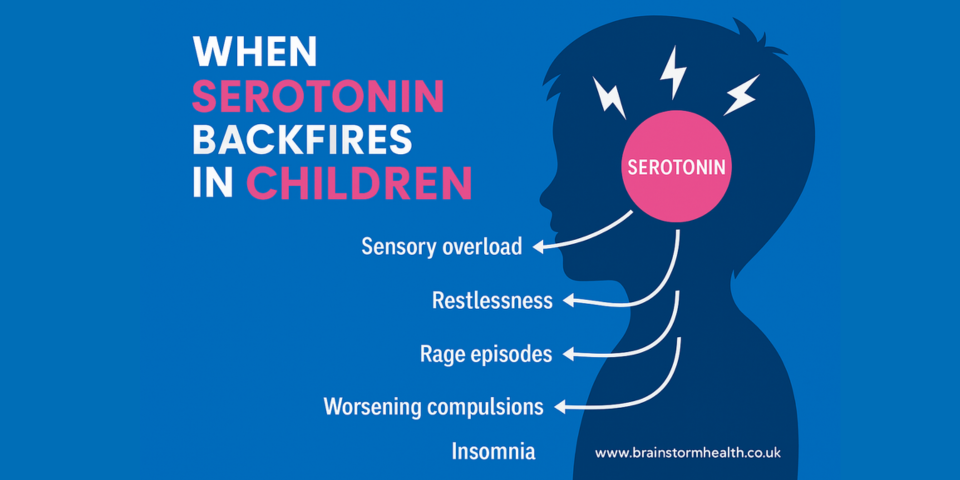
Serotonin has been hailed as the chemical that keeps children calm. Families are told it helps with anxiety, sensory overload, compulsive behaviour and emotional storms. Our clinical testing tells a different story.
In children with autism, PANDAS and PANS a single pattern keeps showing up. It is clear and repeatable. It links unstable behaviour directly to the gut’s serotonin system. Furthermore, it explains why some children improve on serotonin based treatments while others unravel.
THE GUT’S SEROTONIN IS NOT THE BRAIN’S SEROTONIN
The gut produces almost all of the body’s serotonin, while the brain produces its own supply. These two pools do not interact. Gut serotonin cannot cross into the brain, and it cannot directly lift mood or settle anxiety.
Gut serotonin still affects the brain via the vagus nerve, immune signals, and inflammatory chemicals made inside the gut. When the gut produces serotonin at the wrong time the vagus nerve reports stress. As the brain reacts, sensory filters weaken, sleep fragments, and behaviour becomes volatile. This is a biochemical process.
THE FIVE PART GUT SEROTONIN SIGNATURE WE SEE AGAIN AND AGAIN
High 5 HIAA
Serotonin is being broken down rapidly. As a result, children often become more agitated or more sensitive when serotonin is increased with medication or supplements.
High p cresol sulfate
This is produced by specific gut bacteria. When this is high, irritability rises and resilience collapses. Parents describe children who “tip” at the smallest challenge.
High indoxyl sulfate
When tryptophan is being pushed into a toxic pathway, energy is drained and the nervous system is destabilised. These children often react badly to tryptophan or 5 HTP.
Quinolinic pathway imbalance
Inflammation forces tryptophan into the kynurenine pathway, thus quinolinic acid, which is neurotoxic, rises and kynurenic acid falls. The child becomes wired and exhausted at the same time.
Microbiome disruption
Clostridia overgrowth
Enterococcus. Streptococcus
Low Bifidobacterium
Low Lactobacillus
Low butyrate
High beta glucuronidase
This pattern pushes gut serotonin into overactivity and feeds neuroinflammation.
This combination appears repeatedly in autism, PANDAS, PANS, ADHD and sensory processing disorders, turning serotonin from a calming chemical into a stress signal.
WHY SOME CHILDREN CRASH ON SSRIs, 5 HTP AND TRYPTOPHAN
If the gut is already forcing serotonin into high turnover, adding more serotonin pressure pushes the system further off balance. Parents see:
Sensory overload
Restlessness
Rage episodes
Worsening compulsions
Insomnia
Loss of tolerance
WHAT PARENTS CAN DO: THE PRACTICAL ROADMAP
Calm Gut Inflammation
When gut inflammation drops, serotonin output becomes steadier.
Remove obvious irritants.
Address post infection flares.
Support the gut lining.
Rebalance the Microbiome
Reduce Clostridia and other overgrowths that distort serotonin production.
Increase beneficial species that regulate tryptophan use.
Restore butyrate.
Lower beta glucuronidase.
Support Tryptophan Metabolism
Ensure nutrients required for healthy pathways are present: B6, B2, magnesium, zinc, copper, liberated iron and folate. These guide tryptophan away from the toxic routes.
Reduce the Load on the Vagus Nerve
Stabilise the gut and lower inflammatory signalling. When the vagus nerve stops reporting danger the brain stops reacting as if danger is present.
Understand When Serotonin Raising Treatments Are Unsafe
If high 5 HIAA, p cresol or indoxyl sulfate are present, boosting serotonin can worsen the situation.
When these markers fall, tolerance improves.
WHAT HAPPENS WHEN THE SYSTEM IS CORRECTED
When gut inflammation drops, microbiome balance improves and tryptophan metabolism is restored, the pattern changes.
5 HIAA falls.
Toxins fall.
Quinolinic acid drops.
Kynurenic acid rises.
The vagus nerve steadies.
The brain steadies.
Parents report:
Fewer sensory crashes
More predictable behaviour
Longer sleep
More focus
Less panic
More connection
THE CORE TRUTH
When the gut is stable serotonin supports regulation.
When the gut is inflamed serotonin warns of danger.
Understanding this distinction changes everything.
Cut the Clutter, Keep the Science – Weekly Insights
Sign up free
IMPORTANT
This information is for educational purposes only and is not a substitute for professional medical advice, diagnosis, or treatment. Always consult with medical doctors or qualified functional medicine practitioners before introducing any new supplement or intervention.
Concerned about your child’s health? We’d love to have a chat with you.
References
Aaldijk, E., et al., 2022. The role of serotonin within the microbiota gut brain axis in Alzheimer’s disease: a narrative review. Ageing Research Reviews, 75, 101511.
ScienceDirect
Hill, Z.R., Flynn, C.K., Adams, J.B., 2024. Indoxyl sulfate and autism spectrum disorder: A literature review. International Journal of Molecular Sciences, 25(23), 12973.
PubMed
Loh, J.S., Mak, W.Q., Tan, L.K.S., et al., 2024. Microbiota gut brain axis and its therapeutic applications in neurodegenerative diseases. Signal Transduction and Targeted Therapy, 9, 37.
Nature
Sittipo, P., Choi, J., Lee, S., et al., 2022. The function of gut microbiota in immune related neurological disorders: a review. Journal of Neuroinflammation, 19(1), 154.
BioMed Central
Huang, F., Wu, X., 2021. Brain neurotransmitter modulation by gut microbiota in anxiety and depression. Frontiers in Cell and Developmental Biology, 9, 649103.
Frontiers
Chernikova, M.A., et al., 2021. The brain gut microbiome system: pathways and applications to autism spectrum disorder. Nutrients, 13(12), 4497.
MDPI