
Why Does L-Theanine Calm One Child and Make Another Much Worse?
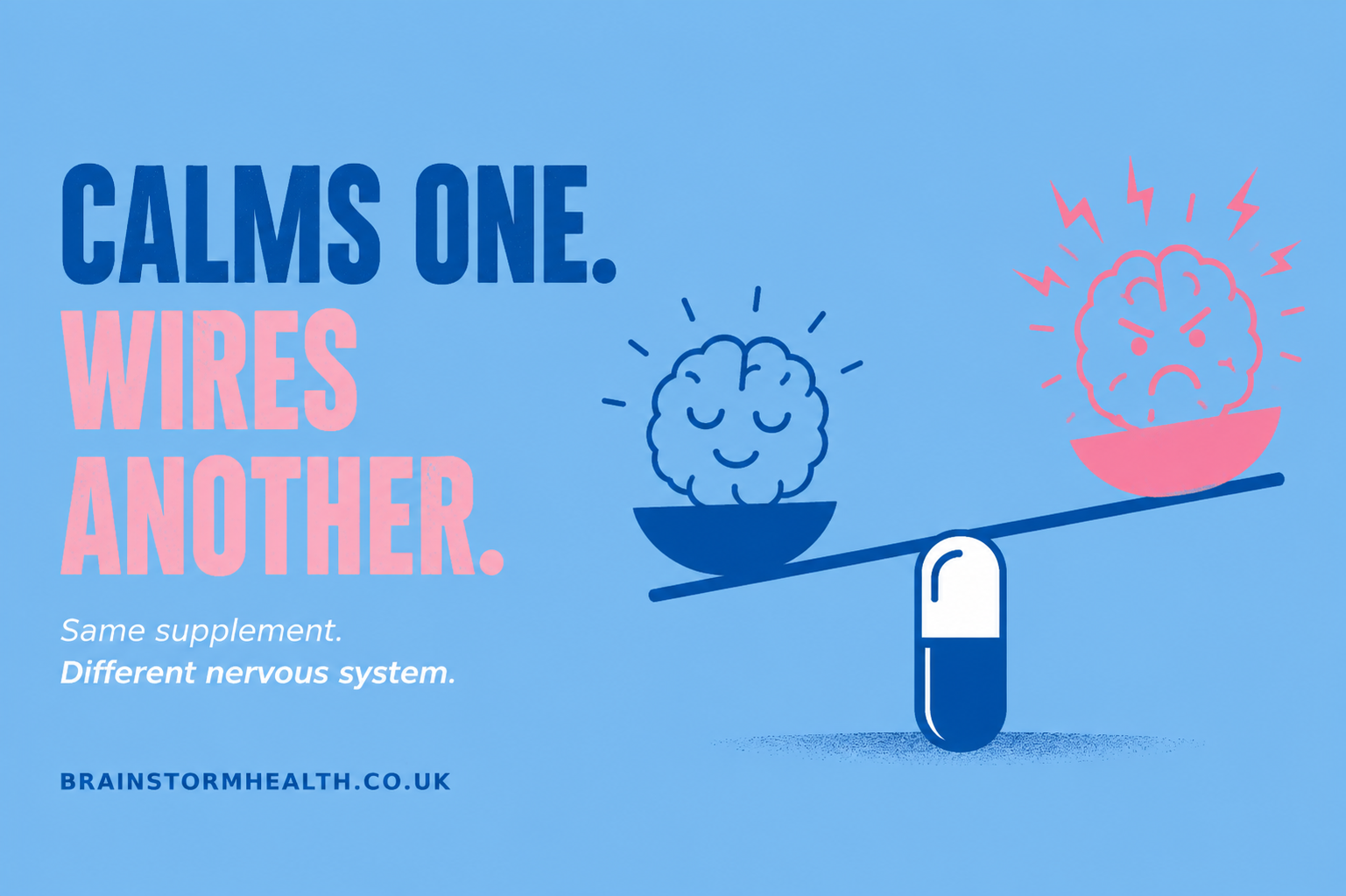
Have you tried L-theanine for your child? Maybe they were was anxious, or couldn't switch off at night. Sometimes it works really well: they are calmer without being sleepy, thus bedtime gets easier. The constant sense that their nervous system is running at full speed finally comes down a notch.
Yet, I've also seen the complete opposite: a child becomes more anxious and irritable, or suddenly they can’t sleep. In some children, their tics and OCD gets worse. Understandably, parents are baffled.
How can something that is supposed to calm the brain make a child more wired?
The answer is that L-theanine is doing considerably more in the brain than the label on the bottle would have you believe.
L-theanine isn't just a "calming amino acid"
One of the problems with supplements is that they get reduced to one-line explanations.
Magnesium = calming
L-theanine = lowers cortisol
Melatonin = sleep
Biology isn't that tidy
L-theanine crosses into the brain and interacts with several of the systems involved in how we regulate anxiety, attention, movement, sleep and inhibition, including GABA, glutamate and dopamine. The effect of changing those systems depends on what they were doing before you gave the supplement.
“A supplement can be calming in one nervous system and activating in another. The question is not what L-theanine is supposed to do. It’s what it does in your child.”
Two children can look anxious for completely different reasons
Imagine two children who both look wired and anxious: the first child is tense and vigilant. At night they are tired but still can't settle. Their body seems permanently braced for something to happen. L-theanine might work really well for this child.
Now, imagine another child who is also anxious, but the picture is different. Fluctuating symptoms, wth worsening tics and OCD. They can go from relatively settled to completely dysregulated within days.
On the surface, both children have "anxiety", but underneath, they may have very different nervous systems. I suspect that distinction explains quite a lot of the very different reactions we see.
It may be better for an over-alert brain than an unstable one
There is a difference between a nervous system that is too switched on and one that is struggling to regulate its signals properly. L-theanine seems particularly well suited to children who are
The child who is:
Physically tense
Vigilant
Stress-driven
Unable to switch off
Restless at bedtime
Anxious but otherwise fairly stable
I am much more cautious when I see:
Active tics
Rapidly changing OCD
A significant PANS/PANDAS flare
Sudden behavioural volatility
Worsening symptoms during infection
A history of reacting badly to supposedly calming supplements
That doesn't mean every child with PANS, PANDAS or autism should avoid L-theanine.
Why do tics and OCD make me pay attention?
The parts of the brain involved in tics and OCD are heavily dependent on some of the same signalling systems that L-theanine can influence. Dopamine is particularly important in the basal ganglia, the deep brain structures involved in movement, habits, inhibition and repetitive behaviour. In a reasonably stable system, altering those signals may be helpful, but in a system that is already struggling to regulate them, the result may be unpredictable. In the latter, it’s a sign that L-theanine is not suited for that child’s nervous system.
What about autism?
Two autistic children can have completely different biology underneath what looks like a similar diagnosis. One may be predominantly anxious and hyperaroused and respond wonderfully, while another may have significant sensory volatility, tics, OCD, sleep disruption and a history of paradoxical reactions.
The question is always: what is happening in this child?
And what about PANS and PANDAS?
A child with PANS may tolerate something perfectly well when stable and react completely differently during a flare. The nervous system they are giving it to today may not be in the same state it was six months ago.
If OCD has suddenly escalated, tics have returned, sleep has deteriorated and the child is clearly in an inflammatory flare, I am generally much less interested in introducing something that changes several neurotransmitter systems at once.
Is it the COMT gene?
COMT helps break down catecholamines including dopamine, so it is tempting to blame a "slow COMT" gene whenever a child reacts badly to something affecting neurotransmitters. COMT could certainly be one small piece of an individual child's response, but I would not look at a COMT result and decide from that whether a child should or shouldn't take L-theanine.
Who do I think L-theanine suits best?
The child I am most interested in using it with is the child who looks over-alert rather than neurologically unstable. The child I am much more cautious with is the one whose picture is currently dominated by tics, abrupt OCD, significant behavioural volatility or an active PANS/PANDAS flare.
What if my child reacts badly to it?
Believe what you are seeing. If you introduce L-theanine and your child becomes noticeably more anxious, irritable, wakeful, compulsive or ticcy, don't keep increasing it because someone told you it is supposed to be calming. That reaction may also be telling you something useful about the kind of nervous system you are dealing with.
IMPORTANT
This information is for educational purposes only and is not a substitute for professional medical advice, diagnosis or treatment. Always consult with medical doctors or qualified functional medicine practitioners before introducing any new supplement, test, or intervention.
If this has raised questions about your child, we'd love to help you find some answers.
REFERENCES
Nathan PJ, Lu K, Gray M, Oliver C. The neuropharmacology of L-theanine (N-ethyl-L-glutamine): a possible neuroprotective and cognitive enhancing agent. Journal of Herbal Pharmacotherapy. 2006;6(2):21-30. PMID: 17182482. PubMed
Lyon MR, Kapoor MP, Juneja LR. The effects of L-theanine (Suntheanine®) on objective sleep quality in boys with attention deficit hyperactivity disorder (ADHD): a randomized, double-blind, placebo-controlled clinical trial. Alternative Medicine Review. 2011;16(4):348-354. PMID: 22214254. PubMed
Scheid L, Ellinger S, Alteheld B, et al. Kinetics of L-theanine uptake and metabolism in healthy participants are comparable after ingestion of L-theanine via capsules and green tea. Journal of Nutrition. 2012;142(12):2091-2096. doi:10.3945/jn.112.166371. PMID: 23096008. PubMed
Kimura K, Ozeki M, Juneja LR, Ohira H. L-Theanine reduces psychological and physiological stress responses. Biological Psychology. 2007;74(1):39-45. PMID: 16930802.
