
When Gut Work Backfires
When Gut Work Backfires
In clinic, I see many children where the gut looks, at least on paper, like the obvious place to start: erratic digestion, narrow food tolerance, loose stools. Tests show imbalances that seem to point clearly in one direction, and everything seems to point the same way.
And yet, when families do exactly that, the opposite of what they expect can happen: sleep becomes fragmented, anxiety emerges, behaviour becomes brittle. Parents describe a child who had been coping, then suddenly isn’t.
The Importance of Gut Development
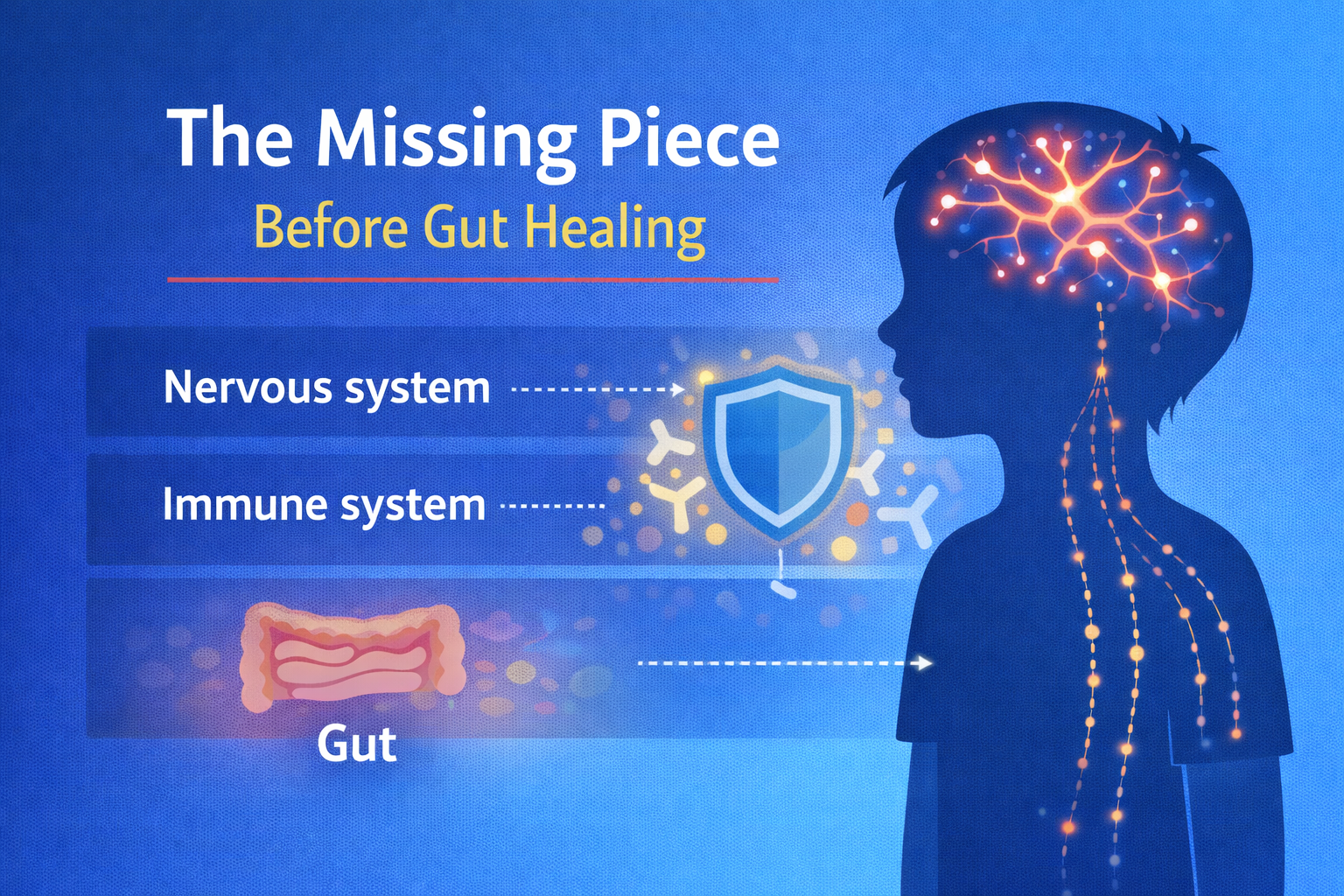
The gut is a decision-making centre. It constantly assesses what is coming in and decides whether it is safe, questionable, or threatening. Those decisions are shaped by immune signals and nervous system tone.
Another crucial piece is development. A child’s microbiome, immune system, and nervous system mature together over many years. What looks like dysfunction on a test is frequently developmental immaturity, particularly in younger children.
Paediatric microbiome specialist Dr Brad Leech has long highlighted that gut tolerance changes dramatically with age.
In the first two years of life, low microbial diversity is normal. The gut is intentionally simple while the immune system learns basic pattern recognition.
Between two and five years, the gut–immune–brain axis is especially reactive. This is a window where fibres, probiotics, and fermented foods frequently provoke strong reactions, even though those same inputs may be well tolerated later.
Between five and nine years, consolidation begins. In children with neuroimmune vulnerability, this phase often remains fragile. The gut may still react strongly if background inflammation or stress is present.
By adolescence, tolerance typically improves, but only if earlier stages have been supported rather than pushed through. This is why adult gut protocols can destabilise children.
Why the Same Intervention Can Calm One Child and Unravel Another
Development sets the stage, but it’s not the whole story.What matters just as much is physiological load. Inflammation, unresolved infection, mast cell activation, or chronic stress all reduce the system’s spare capacity. When capacity is low, even small additions can overwhelm regulation.
A useful way to picture this is a radio with too much background noise. You can try to adjust the signal, but all you get is distortion due to too much interference.
Behaviour Tells You Before the Gut Does
Parents are often told to judge gut interventions by stools, but clinically, behaviour and sleep change first. Common side effects, such as restless nights, increasing anxiety, or emotional volatility, are early warning signals that the nervous system cannot integrate what has been added.
If behaviour deteriorates before digestion improves, the intervention has come too early.
What Actually Helps the Gut Recover
What we see is that the gut becomes easier to work with once the rest of the system settles.
As inflammation eases, stress signalling reduces, and sleep improves, tolerance tends to increase without any direct gut intervention at all. Foods that once caused reactions may be accepted again. Supplements that previously triggered agitation may no longer register. When immune and nervous system signalling quietens, the gut usually tolerates more. That’s when gut support starts to help rather than destabilise.
Gut support can be genuinely helpful, but only when the system underneath is ready to receive it.
IMPORTANT
This information is for educational purposes only and is not a substitute for professional medical advice, diagnosis, or treatment. Always consult with medical doctors or qualified functional medicine practitioners before introducing any new supplement, test, or intervention.
Concerned about your child’s health? We are happy to talk.
References
Cryan, J.F. and Dinan, T.G., 2012. Mind-altering microorganisms: the impact of the gut microbiota on brain and behaviour. Nature Reviews Neuroscience, 13(10), pp.701–712.
Fung, T.C., Olson, C.A. and Hsiao, E.Y., 2017. Interactions between the microbiota, immune system, and nervous system in health and disease. Nature Neuroscience, 20(2), pp.145–155.
Mayer, E.A., Tillisch, K. and Gupta, A., 2015. Gut/brain axis and the microbiota. Journal of Clinical Investigation, 125(3), pp.926–938.
Borre, Y.E. et al., 2014. Microbiota and neurodevelopmental windows: implications for brain disorders. Trends in Molecular Medicine, 20(9), pp.509–518.
Stewart, C.J. et al., 2018. Temporal development of the gut microbiome in early childhood from the TEDDY study. Nature, 562(7728), pp.583–588.