
Thyroid, SIBO, and Kids with PANS and Autism: The Link Nobody Talks About
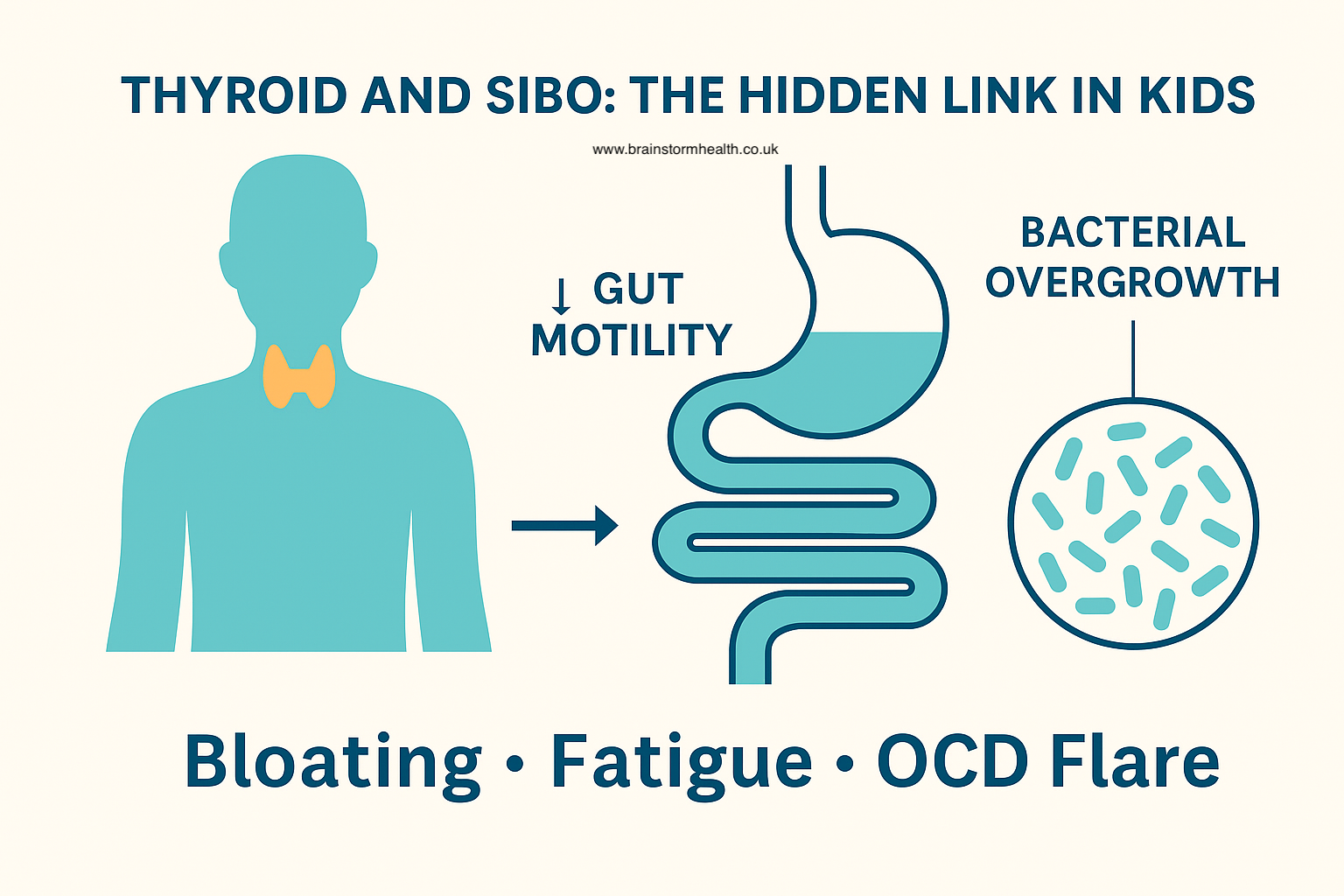
Some kids with PANS, PANDAS, or autism look “gut sick” no matter what you do: bloating that never shifts, constipation that drags on, energy crashes, food refusal, OCD and mood swings, all out of nowhere.
Often, the thyroid is hiding in the background. Low-functioning thyroid, even when blood tests look “normal”, can stall the gut and trigger small intestinal bacterial overgrowth (SIBO).
Why Thyroid Matters to the Gut
Thyroid hormones keep the digestive tract moving. A sluggish thyroid means sluggish gut motility: food sits longer in the small intestine, bacteria build up where they shouldn’t, and bloating or pain follows.
Children with low thyroid function can look like they have IBS, reflux, or chronic “stomach bugs” when really the root is metabolic.
The Thyroid–SIBO Loop
– Low thyroid hormones slow gut transit → bacteria multiply in the small intestine.
– Bacterial overgrowth fuels inflammation, gas, and nutrient loss.
– Inflammation feeds back to the thyroid, often worsening autoimmune tendencies.
– Over time, the child gets stuck in a cycle of gut symptoms, immune dysfunction, and mood or behavioural flare-ups.
Testing Thyroid Properly
Most children only get TSH checked. To see the real picture, you need:
– TSH (thyroid stimulating hormone)
– Free T4 (storage hormone)
– Free T3 (active hormone that drives metabolism)
– Thyroid antibodies (to check for autoimmune activity like Hashimoto’s)
We’ve seen children whose TSH was “normal”, yet their active T3 was far too low. They looked tired, foggy, and constipated for a reason.
What To Do if Results Show Thyroid Stress
Action depends on where the weakness lies:
– Low T4 and high TSH → the thyroid gland itself is underactive. The focus is on medical management and monitoring for autoimmunity.
– Normal T4 but low T3 → poor conversion from T4 to T3. Focus on liver function, selenium, zinc, iron status, and reducing inflammation that blocks conversion.
– Positive antibodies → possible Hashimoto’s process. Focus on calming immune attack: gut repair, lowering triggers such as gluten (where relevant), mould toxins, infections, and balancing vitamin D, selenium, and iodine (with caution).
– Normal bloods but persistent symptoms → explore tissue-level thyroid effect. Hair analysis Ca:K ratio, body temperature tracking, and repeat labs can guide direction.
Wherever the imbalance, two areas always need attention: gut motility (so the small intestine doesn’t stagnate) and immune balance (to reduce overgrowth and autoimmunity). These become the practical targets for diet, lifestyle, and supplement interventions alongside medical care.
Clues from Hair Analysis
If bloods aren’t possible, a hair tissue mineral analysis can hint at thyroid trends. Look at the calcium-to-potassium ratio:
– High calcium + low potassium = functional sign of possible low thyroid.
Calcium is a “brake” on the system, potassium is a “spark plug”. Too much brake, not enough spark, and the thyroid-driven metabolism slows.
Clinical Picture in Kids
In PANS and autism, an underactive thyroid can show up as:
– Chronic constipation or slow bowels
– Bloating and SIBO symptoms
– Fatigue or “zoning out”
– Depression, OCD, or irritability
– Poor temperature regulation
– Food refusal linked to gut discomfort
The Bigger Picture
Many of the children we see with PANS, PANDAS, and autism show subtle thyroid issues missed by routine screening. When thyroid support is addressed, gut health can improve dramatically, and with it, mood, sleep, and learning.
The Takeaway
If your child’s gut seems stuck no matter what you try, look at the thyroid. Testing TSH, T3, T4, and antibodies,or using hair test ratios as clues, can reveal the hidden driver behind chronic gut and behavioural symptoms.
The gut and the thyroid talk to each other. If you only support one, you may never see lasting change.
Join here to get evidence-based insights like this straight to your inbox.
IMPORTANT
The information provided in this article is for educational purposes only and is not a substitute for professional medical advice, diagnosis, or treatment. Always consult with medical doctors or qualified functional medicine practitioners before introducing any new supplement or intervention.
Concerned about your child’s health? We’d love to have a chat with you.
References
Lauritano, E.C., Gabrielli, M., Scarpellini, E., Lupascu, A., Novi, M., Sottili, S., Cammarota, G. and Gasbarrini, A., 2007. Association between hypothyroidism and small intestinal bacterial overgrowth. Journal of Clinical Endocrinology & Metabolism, 92(11), pp.4180–4184.
Ruscio, M., Guard, G., Piedrahita, G. and D’Adamo, C.R., 2022. The relationship between gastrointestinal health, micronutrient concentrations and autoimmunity: a focus on the thyroid. Nutrients, 14(17), p.3572.
Knezević, J. and Stojanović, N., 2020. Thyroid–gut axis: How does the microbiota influence thyroid function? International Journal of Molecular Sciences.
Wang, B., Shen, L., Li, Y., Li, N., Chen, D. and Wu, Y., 2021. Small intestinal bacterial overgrowth in subclinical hypothyroidism during pregnancy: prevalence and associated factors. Frontiers in Endocrinology, 12, 604070.
ENDO 2025. Hypothyroidism linked to increased risk of SIBO; underactive thyroid associated with higher SIBO risk—reported. GI & Hepatology News / Medscape, July 2025.